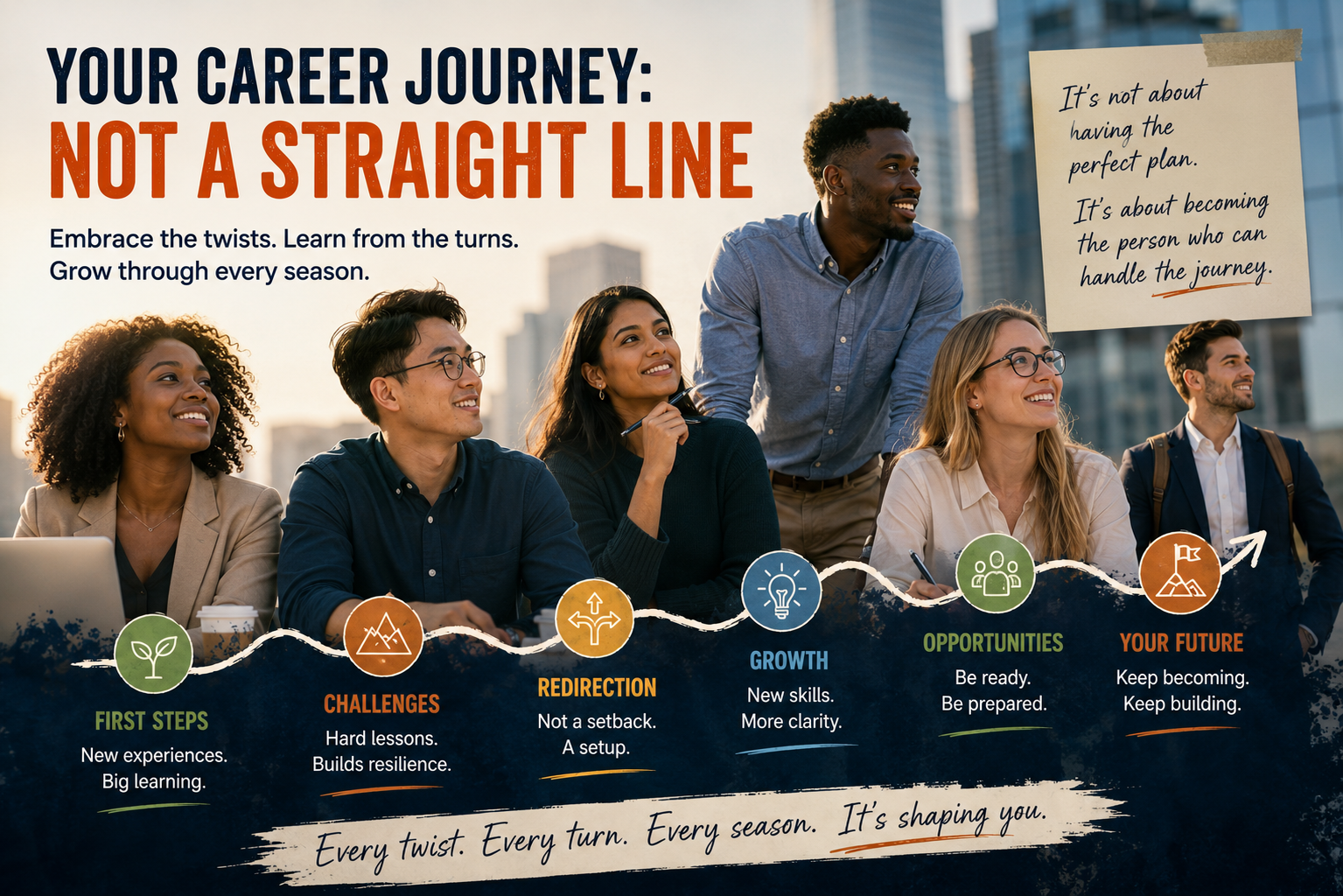
When I wrote The Art of Transformation, one of the things I wanted to show was that life doesn’t move in a straight line. It rarely unfolds exactly the way we planned. There are peaks, valleys, detours, disappointments, breakthroughs, and moments that force us to stop and ask who we’re becoming through it all.
I know this because I’ve lived it. My life and career have taken me through seasons of success, struggle, rebuilding, reinvention, and transformation. I’ve had moments where everything seemed to be moving forward, and I’ve had moments where the road suddenly changed beneath my feet. What I’ve learned is that those moments aren’t interruptions to the journey. They’re part of the journey. In many ways, they’re where the real growth happens.
That’s why I believe early career professionals need to understand this from the beginning. Your career probably won’t move in a straight line. It’ll come with unexpected turns, difficult lessons, and seasons where you may feel unsure of what comes next. But those experiences can shape you if you’re willing to pay attention, tell yourself the truth, and keep moving forward.
When you’re early in your career, it’s easy to believe the goal is to figure everything out as quickly as possible. You want the right job, the right title, the right company, the right manager, and the right path. You look around and it feels like everyone else is moving faster, making better decisions, or somehow holding a map you never received.
But most people don’t have a map. They have moments. They have choices. They have experiences that teach them what they couldn’t have learned any other way.
The beginning of your career isn’t supposed to be perfect. It’s supposed to be formative. It’s where you learn how to work, how to listen, how to receive feedback, how to build relationships, how to recover from mistakes, and how to keep showing up when the work gets hard or the direction feels unclear.
That’s the part we don’t always tell young professionals enough. Early career isn’t just about getting ahead. It’s about learning how to become.
Your Career Isn’t a Perfect Climb
For years, people have talked about careers like they are ladders. You start at the bottom, work hard, climb one rung at a time, and eventually make your way to the top. That sounds simple, but it’s not how most careers actually work.
Real careers have movement, pauses, redirections, and hard lessons. Sometimes you’ll move forward quickly, you’ll feel stuck, or sometimes you’ll take a role that looks like a step back, only to realize later it gave you the experience you needed. Sometimes a job you didn’t love will teach you discipline. Sometimes a manager who challenged you will teach you how to communicate, advocate for yourself, and build emotional strength.
None of that feels good in the moment. Nobody wakes up excited to learn patience through frustration. But those seasons matter because they build something in you that success alone can’t build. They build resilience, perspective, maturity, and the ability to keep going when life doesn’t hand you the clean version of the story.
If you expect your career to be a straight line, every delay will feel like failure, the missed promotion will feel like rejection, and every difficult circumstance will make you question whether you’re on the wrong path.
But when you understand that the road will twist and turn, you can stop overreacting to every hard moment and start asking better questions.
You can ask, “What’s this teaching me? What skill do I need to build? What truth do I need to face? Who am I becoming through this?”
That’s how experience turns into growth.
Your First Job Doesn’t Define Your Future
One of the biggest mistakes early career professionals make is believing their first job defines their future. It doesn’t.
Your first job matters, but it doesn’t own your story. Your first title matters, but it doesn’t decide your worth. Your first manager matters, but they don’t get to write the rest of your career. The first few years are important because they teach you how to show up, how to learn, how to manage pressure, and how to build a reputation.
You may start in a role that isn’t your dream job or take a position because it’s the opportunity in front of you. You may find yourself doing work that feels smaller than your ambition and wonder, “Is this really what I went to school for?”
That’s normal. But don’t dismiss the circumstance too quickly.
Sometimes the role that feels small is teaching you how to be dependable. Sometimes the work that feels repetitive is teaching you discipline, the environment that feels difficult is helping you understand the kind of culture you want to be part of later, or the assignment you didn’t want becomes the experience that prepares you for the opportunity you’ve been asking for.
Early career is full of hidden lessons. You don’t always see them while you’re living them because you’re too close to the frustration. But later, when you look back, as I’m doing now, you may realize that nothing was wasted.
Don’t Just Chase Titles. Build Capacity.
Ambition is a good thing. Wanting to grow, earn more, have more influence, and move into bigger opportunities isn’t wrong. Titles, money, and opportunity matter. Nobody’s building a career just for inspirational quotes and a company mug.
But if you chase titles before building capacity, you can end up i rooms in rooms you’re not fully ready to sit in.
Capacity is what allows you to carry more responsibility without losing yourself. It’s the discipline to follow through, the consistency to do the work even when nobody’s clapping, and the ability to communicate clearly, solve problems, manage pressure, receive feedback, and build trust with people around you.
Early in your career, you should be asking whether you’re becoming more reliable and learning how to solve real problems. You should be asking whether you’re building relationships before you need them, and whether you’re becoming someone people can trust with more.
Those things may not always feel exciting, but they build your reputation. And reputation is one of the most important assets you’ll ever have.
People remember who shows up prepared. They remember who follows through. They remember who owns mistakes. They remember who stays calm under pressure. They remember who listens, learns, and adjusts. That’s how careers are built over time. Not just by chasing the next thing, but by becoming the kind of person who’s ready when the next thing arrives.
The Valleys Matter Too
Everyone likes the peaks. The peaks are the moments when you get the job, receive the promotion, land the project, earn the praise, or finally feel like someone sees your work. Those moments matter because they give you confidence. They remind you that your effort is paying off.
But the valleys matter too.
The valleys are the moments when things don’t happen as quickly as you hoped. The promotion goes to someone else, the feedback stings, the manager doesn’t support you the way you expect, or the company changes direction. The role you wanted disappears and the path feels unclear.
Those moments can be discouraging, especially early in your career. It’s easy to take everything personally because you’re still building your confidence. You’re still trying to prove to yourself and others that you belong.
But valleys aren’t always signs that something is wrong. Sometimes valleys are where the real training happens.
They teach you how to stay grounded and separate your worth from one outcome. They teach you how to recover, ask for help, and keep moving even when the applause gets quiet. The valley is where you learn that you can be disappointed and still be disciplined. You can be frustrated and still be focused. You can be unsure and still take the next right step.
That’s not easy, but it’s powerful. Because the people who learn how to grow in the valley are often the ones most prepared when the next peak comes.
Feedback and Comparison Are Part of the Journey
Feedback can feel personal when you’re early in your career. When you’re trying hard and someone points out something you missed, it can feel like criticism of who you are. But feedback isn’t always an attack.
Sometimes it’s a gift, even if the delivery could use a little professional seasoning.
You don’t have to agree with every piece of feedback. Some of it will be helpful, some incomplete, or unfair. But if you learn how to listen without immediately becoming defensive, you give yourself a chance to grow.
The same is true with comparison. It’s hard to watch someone else get promoted, land the role, or post the big announcement while you’re still trying to figure out your next step. But comparison can make you judge your whole journey against someone else’s highlight reel.
You don’t know the full story behind their success. You don’t know what they struggled with, what doors closed, or what they had to sacrifice. Comparison can make you rush, and rushing can make you chase roles that aren’t right for you.
The better question isn’t, “Why am I not where they are?”
The better question is, “What am I supposed to be learning where I am?”
That question brings you back to yourself.
You’re Not Behind. You’re Becoming.
If I could tell early career professionals one thing, it would be this: you’re not behind just because your path doesn’t look like someone else’s.
You’re becoming.
There’s a difference. Being behind assumes there’s one fixed timeline and you’re failing to keep up with it. Becoming understands that your career is shaped by experiences, lessons, choices, relationships, setbacks, and growth that don’t always fit neatly into a schedule.
You may not understand every situation while you’re in it. That’s normal because some lessons only make sense later. Some experiences only reveal their value after you’ve moved further down the road.
So don’t waste the beginning of your career trying to make it look perfect. Use it to learn. Use it to build discipline. Use it to understand yourself. Use it to develop your voice. Use it to build real relationships. Use it to discover what kind of work gives you energy and what kind of environments bring out your best.
Because the goal isn’t just to get ahead. The goal is to grow into someone who can sustain success when it arrives.
Your early career probably won’t be a straight line. And honestly, that may be one of the best things for you. The straight line may look easier, but it doesn’t always build depth. The twists teach you adaptability. The valleys teach you resilience. The peaks teach you confidence. The setbacks teach you humility. The unexpected opportunities teach you to stay open.
That’s not failure.
That’s transformation.
Your early career isn’t just where you start working. It’s where you start becoming. And if you can learn to stay disciplined, tell yourself the truth, build consistency, and keep making small shifts forward, you won’t just build a career.
You’ve been doing the work. Reading the books. Listening to the podcasts. Journaling at 5 AM. And you’re making progress—but it’s slow, lonely, and sometimes you wonder if you’re even moving in the right direction. Here’s what you’re missing: other people on the same path. Transformation isn’t a solo sport. The breakthroughs happen faster, go deeper, and actually stick when you’re surrounded by people who get it—who are asking the same hard questions, fighting the same inner battles, and committed to becoming more. > Learn More