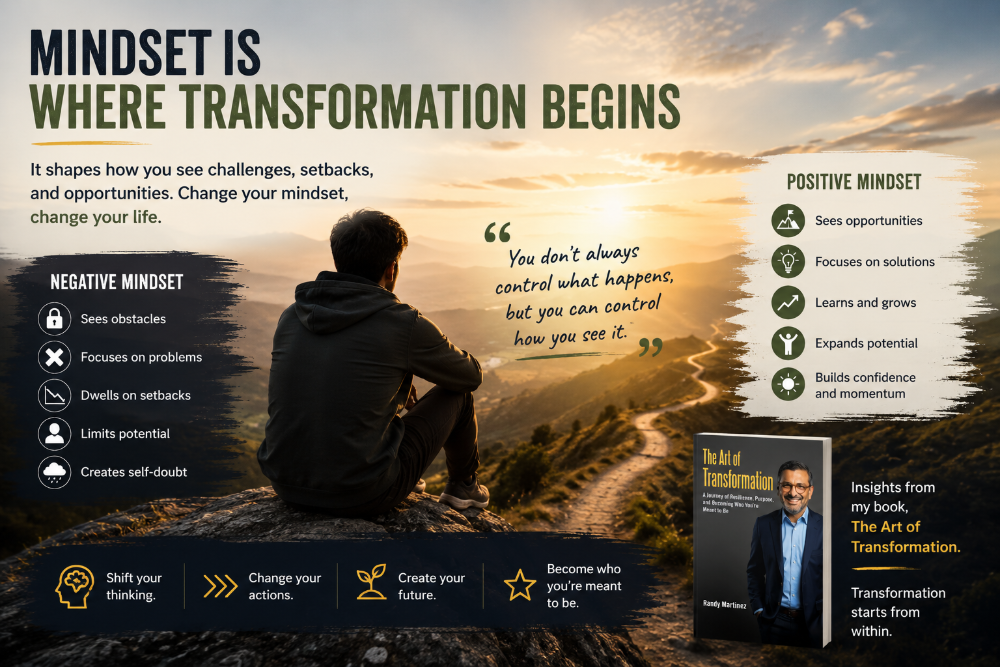
When I wrote The Art of Transformation, I wanted to show that transformation is not just about changing what we do. It’s also about changing how we see ourselves, our challenges, and the road in front of us. Life has a way of testing what we believe long before it reveals what we’re becoming.
That’s why mindset matters.
When people talk about transformation, they often focus on the visible parts of the journey. They talk about the goals, the habits, the routines, the plans, the discipline, and the action steps. All of those things matter. You can’t transform your life without doing the work. But before the work becomes consistent, something deeper has to shift first.
Your mindset.
Mindset is often overlooked in the transformation journey, but it may be one of the most important parts of the process. It shapes how you see yourself, how you respond to challenges, how you interpret setbacks, and how you decide what’s possible for your life. It’s the lens you look through every day, and that lens has a powerful impact on what you believe you can become.
If your mindset is healthy, you’re more likely to see challenges as opportunities to grow. You may still feel fear, frustration, or uncertainty, but you don’t allow those feelings to become the final decision. You learn how to pause, reflect, and ask yourself what the moment is trying to teach you. A positive mindset doesn’t mean you pretend everything is easy. It means you believe that even hard things can shape you, strengthen you, and move you forward.
But when your mindset is negative, it can quietly become a barrier. It can make every challenge feel like proof that you’re not ready. It can make every mistake feel like failure. It can make every delay feel like rejection. Over time, that kind of thinking can erode your progress before you even realize it’s happening.
That’s why transformation can’t just be about changing what you do. It also has to be about changing how you think.
I’ve learned this in my own life. There have been moments when I had every reason to believe the story was over, or at least that the road ahead was going to be too hard to walk. I’ve had times where life didn’t go the way I planned, where doors closed, where I had to rebuild, where I had to sit with disappointment and still figure out how to move forward.
In those moments, the biggest battle wasn’t always outside of me. Sometimes the biggest battle was the conversation happening inside my own mind.
I had choices to make. Would I see the setback as the end, or would I see it as a turning point?
Would I define myself by what happened, or would I let the experience teach me something?
Would I stay stuck in what I lost, or would I begin asking what I could build from where I was?
That’s where mindset becomes powerful. It doesn’t remove the difficulty, but it changes how you carry it. It gives you a way to look at the same situation with a different level of honesty, courage, and hope.
Mindset Shapes What You See
Two people can go through the same kind of setback and respond in completely different ways. One person may see it as confirmation that they are not good enough. Another person may see it as a hard lesson that’s preparing them for something better.
Usually, the difference is mindset.
Your mindset shapes what you notice, what you believe, and whether you see obstacles as walls or as invitations to grow. It also shapes the story you tell yourself when life gets difficult.
And the story matters.
If you constantly tell yourself that you’re behind, not capable, unlucky, overlooked, or too far gone, eventually you’ll start making decisions from that place. You will hesitate, shrink, and avoid opportunities. You will talk yourself out of rooms you were meant to enter.
But if you begin telling yourself a different story, one rooted in growth, truth, and possibility, then your actions begin to change. You start showing up differently. You start taking small steps, and you start building evidence that you’re capable of more.
That doesn’t happen overnight.
But it starts with the way you choose to see yourself and your situation.
A Positive Mindset Is Not Fake Positivity
I think it’s important to be clear about this. A positive mindset doesn’t mean pretending everything is fine when it’s not. It doesn’t mean smiling through pain or ignoring reality. That’s not transformation. That’s avoidance with a motivational quote taped to it.
Real mindset work requires honesty.
It means being able to say, “This is hard, but I can learn from it.”
It means saying, “I’m disappointed, but I’m not done.”
It means saying, “I made a mistake, but I can take ownership and grow.”
It means saying, “This season doesn’t look the way I wanted it to look, but there’s still something I can do with it.”
That’s not fake positivity. That’s resilience.
A strong mindset doesn’t deny the valley. It helps you walk through it with purpose.
The Mind Can Either Build Momentum or Break It
One of the reasons mindset matters so much is because it influences momentum. When you believe change is possible, you are more likely to take action. When you take action, even small action, you create progress. And when you create progress, you begin to build confidence, and that confidence becomes fuel.
But the opposite is also true. When you believe nothing will change, you stop trying. When you stop trying, nothing moves. When nothing moves, you start believing the negative story even more. It’s a vicious cycle that keeps people stuck for years.
This is why small shifts in mindset matter, because sometimes transformation begins with one better thought, question, decision, or small action that proves you don’t have to stay where you are.
You may not be able to change everything in your life at once, but you can begin changing the way you respond. You can begin changing the way you speak to yourself, or the way you interpret hard moments. That shift may seem small, but small shifts repeated over time can change the direction of your life.
Final Thought
In The Art of Transformation, one of the ideas I come back to is that transformation is not one big moment. It’s a series of choices, reflections, lessons, and actions that slowly shape who we become. Mindset is a major part of that because before you can move differently, you often have to see differently.
Mindset is not the whole transformation journey, but it is where much of the journey begins.
Before you change your habits, you have to believe change is possible and before you build discipline, you have to believe your effort matters. Therefore, before you move forward, you have to stop letting old stories convince you that you can’t.
Remember, your mindset is the lens, and when the lens changes, the road begins to look different.
The challenge may still be there. The setback may still be real. The work may still be hard. But with the right mindset, you begin to understand that hard doesn’t mean impossible, or that slow doesn’t mean failure. A setback doesn’t mean the story is over.
Sometimes it means transformation is beginning.
And when you start to see life that way, you don’t just move differently.
You’ve been doing the work. Reading the books. Listening to the podcasts. Journaling at 5 AM. And you’re making progress—but it’s slow, lonely, and sometimes you wonder if you’re even moving in the right direction. Here’s what you’re missing: other people on the same path. Transformation isn’t a solo sport. The breakthroughs happen faster, go deeper, and actually stick when you’re surrounded by people who get it—who are asking the same hard questions, fighting the same inner battles, and committed to becoming more. > Learn More
 When I wrote The Art of Transformation, I wanted to show that transformation is not just about changing what we do. It’s also about changing how we see ourselves, our challenges, and the road in front of us. Life has a way of testing what we believe long before it reveals what we’re becoming.
